💡Why Every Modern Team Needs a DevOps Pipeline
Software development has changed dramatically in the past decade. Gone are the days of shipping code once every few months. Today, businesses demand fast, reliable, and frequent software releases — sometimes multiple times per day.
But here’s the challenge:
- Every time you push new code, there’s a risk of breaking something.
- Manual deployments are slow and prone to human error.
- Development and operations teams often struggle to stay in sync.
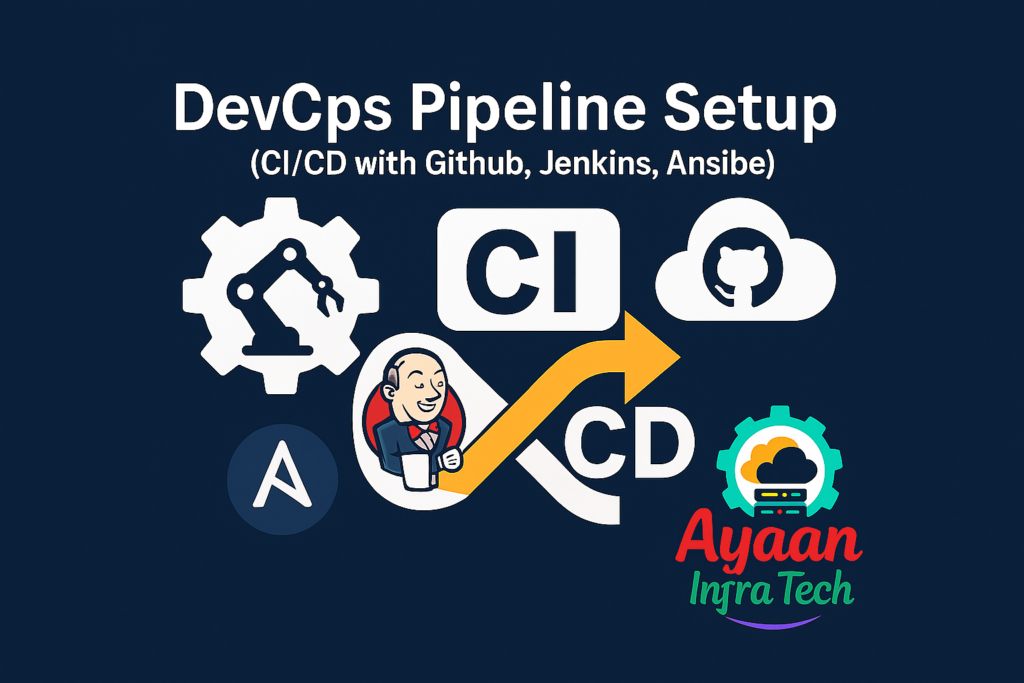
That’s where a DevOps pipeline comes in. Using tools like GitHub, Jenkins, and Ansible, we can build a Continuous Integration & Continuous Deployment (CI/CD) system that automates the entire process — from writing code to deploying it in production.
💬 “A great pipeline is like a high-speed train for your code — safe, fast, and always on time.”
🛠 What is a CI/CD Pipeline?
A CI/CD pipeline is a series of automated steps that developers follow to deliver software updates quickly and reliably.
Think of it like an assembly line in a factory — each stage has a specific job, and automation ensures consistency.
CI – Continuous Integration
🔹 Developers commit code to a shared repository (GitHub).
🔹 Automated builds and tests run immediately to catch bugs early.
CD – Continuous Deployment (or Delivery)
🔹 After passing tests, code automatically deploys to staging or production.
🔹 Ansible ensures deployments are consistent across environments.
⚙ Why GitHub + Jenkins + Ansible is the Perfect Combo
When setting up a DevOps pipeline, tool choice matters. Our preferred stack is:
1️⃣ GitHub – Code hosting & version control
- Handles pull requests, branching, and collaboration.
- Integrates seamlessly with Jenkins for automated builds.
2️⃣ Jenkins – CI/CD automation engine
- Open-source, highly customizable.
- Supports complex workflows like build → test → deploy.
3️⃣ Ansible – Configuration & deployment automation
- Idempotent playbooks ensure predictable deployments.
- Works on cloud, on-premise, and hybrid infrastructures.
✅ With these three tools working together, we can achieve speed, safety, and scalability.
🎯 Key Benefits of a DevOps Pipeline
When we set up your pipeline, you can expect:
- ⚡ Faster releases – Push code and see it live in hours, not days.
- 🛡 Higher reliability – Automated testing reduces production bugs.
- 📈 Improved collaboration – Developers and operations share one workflow.
- 💰 Cost savings – Less downtime, fewer hotfixes, more productivity.
- 🌍 Scalability – Works for small startups or large enterprises.
🔍 Step-by-Step — How a CI/CD Pipeline Works
Here’s a simplified flow of what we build for you:
1️⃣ Developer pushes code → GitHub repository
2️⃣ Jenkins detects change → Triggers automated build
3️⃣ Automated tests run → Unit, integration, and security scans
4️⃣ Ansible deploys to staging → Test in a safe environment
5️⃣ Approval or auto-promotion → Deploy to production
6️⃣ Monitoring alerts → Catch issues before customers notice
📦 Our Packages — Basic, Standard, Premium
| Package | Price | Features |
|---|---|---|
| Basic | $120 | GitHub repo setup, simple Jenkins job, single server Ansible playbook |
| Standard | $240 | Branch strategy, Jenkins pipelines, multi-env Ansible playbooks, basic monitoring |
| Premium | $360 | Full CI/CD (build/test/deploy), rollback support, multi-server/cloud deployment, docs & 1-week support |
🔧 What’s Included in Our Service
- ✅ GitHub configuration & branch strategy
- ✅ Jenkins installation & pipeline jobs
- ✅ Ansible playbooks for automated deployments
- ✅ CI/CD integration across all environments
- ✅ Automated testing hooks
- ✅ Rollback strategy for safe deployments
- ✅ Monitoring & alerting
- ✅ Secure access control
- ✅ Documentation & handover
Real-World CI/CD Use Cases & Success Stories
🏢 1. How a SaaS Startup Reduced Release Time by 80%
Imagine you run a SaaS platform with a growing customer base. Every week, you’re pushing new features, fixing bugs, and making security updates. But without automation, every deployment is a nail-biting event.
Before CI/CD:
- Developers manually uploaded files via FTP.
- Testing was ad-hoc, and sometimes skipped due to time pressure.
- Releases took 3–4 hours, often causing downtime.
After CI/CD with GitHub + Jenkins + Ansible:
- Every commit triggered an automated build and test.
- Jenkins handled the deployment automatically after successful tests.
- Ansible ensured the same configuration was applied on every server.
Result:
- 🚀 Release time dropped from 4 hours to 30 minutes.
- 🛡 Production incidents reduced by 70%.
- 📈 Customer satisfaction improved, with faster feature rollouts.
🏦 2. Financial Firm Automates Security Patches
For financial institutions, security is non-negotiable. One client needed a way to push urgent security patches to dozens of servers without delay.
Solution:
- GitHub stored patch scripts with version control.
- Jenkins pipelines scheduled patch deployment.
- Ansible applied updates across servers in parallel.
Impact:
- ⚡ Patch deployment time reduced from days to hours.
- 🛡 Zero missed updates during critical security windows.
🎮 3. Gaming Company Delivers Weekly Game Updates
Online games need frequent updates for bug fixes, new levels, and seasonal events. A gaming company used our pipeline to make this happen without downtime.
- Jenkins pipelines built the game server updates.
- Ansible rolled updates gradually using a blue/green deployment strategy.
- Players saw zero interruptions during the rollout.
Outcome:
- 🚀 Weekly updates became standard.
- 🎯 Game stability improved thanks to automated testing.
⚠ Common CI/CD Mistakes to Avoid
Even with the right tools, bad practices can ruin a pipeline. Here are common pitfalls:
1️⃣ No Clear Branching Strategy
Without a proper Git branching model, teams merge unstable code into production.
Fix: Use Git Flow or trunk-based development with clear rules.
2️⃣ Skipping Tests
Some teams turn off automated tests to speed up deployments — a dangerous shortcut.
Fix: Keep tests fast and relevant so they’re never skipped.
3️⃣ Hardcoding Secrets
Placing credentials directly in code is a security nightmare.
Fix: Use Jenkins Credentials Store or Ansible Vault for secret management.
4️⃣ Ignoring Rollback Strategies
Without rollback, a bad deployment can bring down production for hours.
Fix: Implement blue/green or canary releases.
🔐 Security Best Practices for Your CI/CD Pipeline
When dealing with production environments, security must be baked into the pipeline — not an afterthought.
🔑 Secure Access Control
- Limit pipeline permissions to necessary accounts.
- Use SSH keys instead of passwords.
🛡 Static & Dynamic Code Analysis
- Integrate linting and security scanning tools into the CI stage.
📜 Audit Trails
- Keep a log of every build, deployment, and change.
- Store logs securely for compliance.
🔒 Encrypt Secrets
- Use Ansible Vault or a secrets manager (AWS Secrets Manager, HashiCorp Vault).
- Never store plain-text credentials in GitHub.
🌍 Technical Requirements to Get Started
Before we start building your pipeline, here’s what we’ll need:
- GitHub repository access (admin or collaborator)
- Server access (SSH or cloud control panel)
- Existing Jenkins/Ansible credentials (optional, we can set them up)
- Test/Staging environment access (recommended)
📈 CI/CD ROI & Productivity Gains
🚀 How CI/CD Boosts Team Productivity
A well-designed Continuous Integration & Continuous Deployment (CI/CD) pipeline doesn’t just automate — it transforms the way teams work.
🔹 1. Faster Feature Releases
Without CI/CD:
- Developers wait for manual approvals.
- QA cycles drag on for days.
With CI/CD:
- New features go from idea → production in hours or days.
- Automated testing ensures safety without delays.
🔹 2. Less Context Switching
When deployments break, developers drop everything to fix issues. CI/CD reduces these interruptions by catching errors early.
🔹 3. Improved Code Quality
Automated tests, linting, and code scans run every commit. Issues are caught before they ever reach production.
🔹 4. Reduced Manual Errors
Every manual deployment step is a chance for human error.
CI/CD removes these steps with repeatable, reliable automation.
💰 Return on Investment (ROI) of CI/CD
Think of CI/CD as an investment that pays back in speed, stability, and scalability.
| Benefit | Impact | Example |
|---|---|---|
| Time Savings | Faster releases | A team of 5 saves 20 hours/week on manual deployments |
| Fewer Incidents | Less downtime | 60% drop in production bugs |
| Better Customer Retention | Happier users | Regular feature updates keep customers engaged |
| Lower Maintenance Costs | Easier scaling | Automated infra setup reduces ops overhead |
🛠 Jenkins Pipelines as Code — A Deep Dive
Jenkins Pipelines as Code means your build and deployment process is stored in your repository as a Jenkinsfile.
This makes pipelines:
- Version-controlled
- Reusable
- Easy to review
Example: Declarative Jenkins Pipeline
groovyCopyEditpipeline {
    agent any
    stages {
        stage('Build') {
            steps {
                sh 'mvn clean install'
            }
        }
        stage('Test') {
            steps {
                sh 'mvn test'
            }
        }
        stage('Deploy') {
            steps {
                ansiblePlaybook credentialsId: 'ansible-key', playbook: 'deploy.yml'
            }
        }
    }
}
✅ Pro Tip: Store your pipeline config in GitHub alongside your code so it evolves with your app.
📦 Our CI/CD Service Packages — Detailed Breakdown
🥇 Basic Package — Starter Automation
Perfect for small teams wanting to try CI/CD without complexity.
- GitHub repo setup & branch strategy
- Simple Jenkins job
- Single-server Ansible playbook
💰 Price: $120
⏳ Delivery: 24 hours
🥈 Standard Package — Multi-Environment CI/CD
Ideal for growing teams with staging + production.
- Advanced branch strategy
- Jenkins pipelines for multiple environments
- Ansible playbooks for dev, staging, prod
- Basic monitoring for builds & deployments
💰 Price: $240
⏳ Delivery: 48 hours
🥇 Premium Package — Full-Scale CI/CD
For companies ready for a production-grade pipeline.
- Full CI/CD (build → test → deploy)
- Rollback strategy (blue/green, canary)
- Multi-server & cloud integration
- Comprehensive documentation + 1 week support
💰 Price: $360
⏳ Delivery: 72 hours
💬 FAQ — Common Questions from Clients
❓ Is this service only for Linux servers?
No — we support Linux, Windows, Docker, and Kubernetes.
❓ Can you integrate with GitHub Actions instead of Jenkins?
Yes — Jenkins is our default, but we can also set up GitHub Actions, GitLab CI, or Bitbucket Pipelines.
❓ What if I don’t have a staging environment?
We can help you create one using cloud providers like AWS, Azure, or DigitalOcean.
❓ How do you handle sensitive credentials?
We use Jenkins Credentials Store or Ansible Vault — no plain-text passwords, ever.